
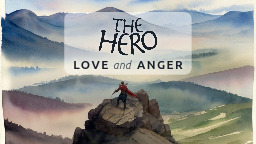
The Hero
↑
argues for
family survival
↓
↑
argues for
physical survival
↓
↑
argues for
tribal survival
↓
Benefits
Passionate, warm, caring
Drawbacks
Possessive, self-absorbed
Benefits
Assertive, savvy, effective
Drawbacks
Vengeful, volatile, cruel
Emotions work like a jury of the three arguments, which combine in beats. Eristic beats are fast, like a heartbeat.
The Hero leads with love and lands on anger to form the characteristic beat of frustration.
The Hero uses love and anger primarily through the frustration beat, making for a bold, decisive, and action-oriented archetype.
Going from love to anger is a big step, in an eristic sense. It argues for adding to the self, while also arguing to modify the world.
Frustration spans from love to anger.
The Hero more easily feels intuitive love-first emotions than cognitive fear-first emotions. Their love is built-in but functional, making them an asset to everyone in their extended self.
The common recurring emotion with a Hero who can't obtain frustration rewards is overwhelming anger. The point of frustration is to serve the self argument with anger. Without success, anger overtakes love in the frustration beat. This can lead to something like a disordered anger-love beat or the zeal beat, anger/pride, the beat where anger is in the driver's seat.
Duress is particularly rough on the Hero, because fear-disgust is an inversion of love-anger. Long periods of duress can overwhelm the Hero.
These are the beats the Hero is good at.
These are the beats the Hero struggles with.
These are the beats the Hero more rarely uses.
Personal rankings: Your score percentage for each archetype is calculated when you complete the test.


The base emotions are like underlying survival needs.
Hatred fulfills disgust and anger, for example.
Duress fulfills fear, guilt and disgust, leaving love, anger and pride unfulfilled.
Explore how the 9 emotional archetypes position across 15 behavioral dimensions. Switch either axis or select a preset.
PRESETS:
YOU
Attachment/envy/zeal cultures are typically family- or individualism-oriented and hard-working.
Devotion/contempt cultures have strict rules, devoted followers and a disdain for outsiders.
Satisfaction culture, usually for smaller groups, focuses on avoiding fear, guilt, disgust and anger.
Satisfying love and anger together is, well, frustrating:
Frustration falls just short of satisfaction.
As a characteristic emotion, frustration is big, cumbersome, and even when achieved, not very satisfying.
The Hero's secret weapon is approaching love and anger separately, through attachment and zeal:
Attachment and zeal are the easiest way to achieve love and anger.
Attachment and zeal put love and anger in the driver's seat, emotion-wise, unlike frustration where it can feel like anger is happening to you.
The Hero's affinity for attachment/zeal makes the archetype a good match for the attachment/envy/zeal pattern:
This societal pattern can serve the Hero's two biggest needs of love and anger.
The Hero will find a good emotional complement in the Fixer, since the Hero isn't inherently good at envy.
The other societal pattern of devotion/contempt is a harder challenge for the Hero. Devotion can serve the Hero's need for feeling love, but doesn't do it as well as attachment which uses the self/world pattern like frustration. Contempt is especially hard for the hero because it abbreviates anger, the Hero's other need.
Frustration just doesn't fit in well with devotion/contempt.
In such a society, the Hero will end up feeling one of two patterns:
Both of these patterns can be destructive for the Hero.
The devotion/hatred/pride pattern is particularly bad for the Hero, because the anger is out of control. Heroes who fall out of the devotion expectation completely will revert to attachment/envy/zeal, ultimately not fitting in with the greater group.
Since the coping emotion shares the same arguments (self/world/society) in inverted polarities, it effectively pauses the characteristic emotion, providing relief from overwhelming intensity.
The coping emotion serves as a shadow archetype, characterizing the feeler in periods of acute emotional stress.
The Hero copes with duress, the combination of fear and disgust.
Duress is best characterized as a feeling of being trapped. It's a difficult emotion to invoke, but the Hero may fall into a pattern of invoking duress in order to escape frustration.
Coping with duress may look like:
Overcommitting: The Hero is generally an asset to groups, and this is where they can feel the most duress, being 'trapped' by their responsibility to the group.
Depression: Duress is the emotion behind depression. It's a 'doing nothing' mode that helps you escape the 'do something' urge of frustration.
Self-perfection: The analysis and discernment of duress may lead the Hero into a pattern of perfecting the self in order to avoid world demands.
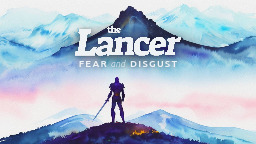
The Hero's coping emotion is the Lancer's characteristic emotion.
The Hero is naturally good at compassion and courage which work like love and anger.
The Hero should aim to develop discretion and honor, which work to moderate love and anger.
The hardest-to-develop virtue for The Hero is fairness, corresponding to their blind spot.
Virtues act like the opposite of their emotion—coping made conscious and disciplined. For The Hero, developing fairness actively balances their unengaged pride argument.